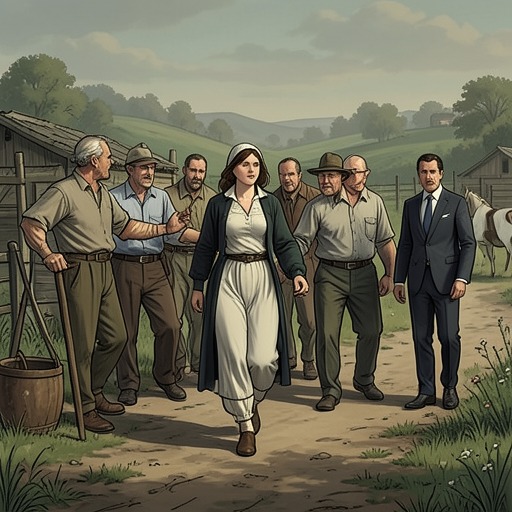
Dean McGrath
The Vampire Prince’s BrideDean McGrath is the creditor and principal antagonist who arrives at Danita Valdez’s inherited farm to transform her uncle’s debt into a weapon against her. His significance lies not merely in demanding repayment, but in treating land, labor, sexuality, and life itself as negotiable forms of payment. Through him, an inheritance that should offer Danita independence becomes the opening through which coercive power enters her home.
Identity and First Appearance
McGrath introduces himself with polished civility, holding out his hand and expressing regret over Danita’s uncle’s suicide. The courtesy is immediately undercut by the menace of his presence. His sun-tanned appearance is associated with artificial grooming rather than ordinary sunlight, while his salt-and-pepper hair and graceful, catlike walk evoke a predator stalking prey. Danita’s physical response—her skin crawling and a shiver passing through her as he approaches—establishes that his danger is communicated before he openly threatens her.
He presents himself as the legal and financial claimant to the farm. According to McGrath, Danita’s uncle owed him approximately five hundred thousand dollars, making the newly inherited land, in his formulation, technically his property. The claim is strategically ambiguous: Danita cannot immediately verify whether the debt is genuine, yet the scale of the amount makes resistance seem nearly impossible. McGrath therefore enters the scene behind the appearance of a creditor while behaving like an extortionist, using financial uncertainty to seize psychological control.
Debt as Coercion
When Danita rejects his demand and points out that the dilapidated farm requires substantial investment before it can become productive, McGrath does not negotiate as an ordinary lender. He warns her not to get on his bad side, invokes her recent bereavement, and offers a supposedly lenient arrangement: a fifty-thousand-dollar down payment within three months, followed by monthly payments. The concession is not generosity. It is a deadline designed to make the impossible appear contractual and to keep Danita under continuing pressure.
Danita tells him that she has no money to give him. McGrath’s answer is deliberately indirect: if she cannot pay in cash, there may be “alternative ways” to settle the debt. His gaze moves slowly down her body, converting an economic conversation into a sexual threat without requiring him to state the proposition plainly. The scene’s value shift is consequently stark. Danita begins with the promise of land and self-sufficiency; McGrath recasts that promise as vulnerability, suggesting that her body may be treated as collateral.
This mechanism makes McGrath more than a conventional loan shark. He exploits inherited debt as a system for dissolving consent. Danita has inherited land but also an obligation she did not create, and McGrath uses that unwanted obligation to claim authority over choices that should remain hers. His power is therefore both material and theatrical: he needs the debt to appear legitimate, but he also needs Danita to feel that refusing him will provoke immediate violence.
Surveillance and the Threat to Danita
McGrath’s control extends beyond the farm and its finances. He has ordered Killian Flanagan and Ryan Higgins to keep watch over Danita, treating her movements and relationships as matters under his supervision. When he confronts Killian about Danita’s pregnancy, he reveals that he regards the pregnancy as a violation of his instructions. His question—why Killian and Higgins believed it acceptable to get Danita pregnant—shows that he imagines himself entitled to regulate her reproduction even while she remains the debtor he is pursuing.
The pregnancy revelation destabilizes Killian, who had seen no obvious signs of morning sickness and cannot tell whether McGrath is stating a fact or manipulating him. That uncertainty strengthens McGrath’s function as a controller of information. He can turn private bodily knowledge into a weapon against both Danita and the men assigned to watch her, making the pregnancy another point of leverage in the surrounding conflict.
McGrath’s possessive logic also exposes the contradiction at the center of his authority. He claims to be enforcing a financial obligation, yet he behaves as though Danita’s body, fertility, and associations are included in the debt. The movement from land ownership to reproductive surveillance is not accidental escalation; it is the same claim of ownership expressed in increasingly intimate forms.
From Intimidation to Lethal Pursuit
McGrath’s menace becomes explicit when Danita attempts to move around him and says she must retrieve more belongings from the truck. He catches her by the arms and refuses to let her leave. He accuses Killian and Higgins of seeking permission from a Lion to kill him, then rejects Danita’s explanation that they intended only to ask for protection or intervention. In his version of events, any attempt to stop him is evidence that his enemies will not rest until he is dead.
After freeing herself, Danita faces a direct death threat. McGrath tells her to run, promising that when he catches her he will tear out her throat and leave her body for the Bears to discover. The language strips away the remaining disguise of creditor, businessman, or negotiator. He becomes an executioner who frames pursuit as sport and murder as a message to Danita’s protectors.
The threat also reveals his strategic use of triangulation. Danita is not threatened only as an individual; McGrath invokes the Bears and their attachment to her, imagining her corpse as a punishment delivered to them. His violence is thus communicative. He seeks to terrorize Danita, challenge Killian and Higgins, and establish that anyone who intervenes will be drawn into the same circle of retaliation.
Narrative Role and Significance
McGrath embodies the overlap between economic exploitation and bodily violence. The five-hundred-thousand-dollar debt, the demanded fifty-thousand-dollar payment, the surveillance order, the pregnancy accusation, the unwanted touch, and the promise of dismemberment form a single continuum rather than separate threats. Each stage narrows Danita’s freedom: first her land is claimed, then her money, then her body, then her reproductive choices, and finally her life.
His characterization depends on the tension between surface control and predatory impulse. He smiles, offers condolences, proposes payment terms, and speaks with the confidence of someone who expects his version of ownership to be accepted. Yet the narrative repeatedly makes the concealed violence visible through physical signs: the catlike movement, Danita’s shivering, the gaze descending over her body, the grip on her arms, and the promise to tear out her throat. The cultivated persona does not soften the threat; it makes the threat more disturbing by showing how easily violence can wear the manners of business.
McGrath’s decisive function in the plot is to turn Danita’s effort to establish herself as a farmer into a struggle for bodily autonomy and survival. His presence gives inherited land an ironic meaning: the property that should secure her future instead attracts a creditor who believes the past can govern every part of her present. Even where the available scenes do not record his final fate, they establish him as the force that makes escape necessary and transforms private debt into open conflict.